.png)
How to Transform Twinmotion Designs into VR on Meta Quest [2026]
- SENTIO VR Team

- Jun 5, 2023
- 8 min read
Updated: Mar 20

Twinmotion is a powerful real-time architectural visualization tool developed by Epic Games. With seamless integrations for Revit, SketchUp, Rhino, ArchiCAD and Vectorworks, architects and designers can produce stunning interactive visualizations, videos, and 360 panoramas directly from their modeling software.
Standalone VR headsets like the Meta Quest 3 and Quest 3S are driving unprecedented demand for wireless, cable-free VR presentations. Professionals want to walk clients through designs in immersive VR without the burden of PC-tethered setups or expensive hardware at the point of presentation.
In this guide, we cover every method available for getting your Twinmotion designs into VR on a Meta Quest headset — from PC-tethered approaches to cloud-based workflows that let anyone view your designs without cables, software installs, or licenses.
Table of Contents
Is There an Official Twinmotion App for Meta Quest?
No. As of 2026, there is no standalone Twinmotion app for Meta Quest. Twinmotion is a real-time rendering software that runs on desktop systems, and while it supports VR headset viewing, it only works with PC-tethered connections. The Meta Quest 3 is supported via Quest Link (wired USB-C cable) or Air Link (wireless over Wi-Fi), but both methods require a powerful PC running Twinmotion.
For the official list of supported headsets and system requirements, see the
Key takeaway: There is no way to run Twinmotion natively on a Meta Quest headset. To view your designs in VR without a PC connection, you need to export 360 panoramas and use a cloud-based VR platform. |
Option 1: PC-Tethered VR with Quest Link / Air Link
If you have a VR-ready PC, you can view your Twinmotion model in real-time VR using the Meta Quest’s Link feature. This gives you full freedom of movement inside the 3D model, but comes with significant hardware and setup requirements.
System Requirements
Requirement | Specification |
CPU | Intel Core i7 / AMD Ryzen 7 or greater |
Operating System | Windows 10 64-bit or newer |
RAM | 16 GB minimum (recommended) |
Video Card | NVIDIA RTX 2070 / AMD RX 5700 XT with 8GB VRAM or better |
Network | 5 GHz WiFi router near PC (for Air Link) |
Headset | Meta Quest 3 (officially supported) |
Setup Steps
Install the Meta Quest app on your PC (previously called the Oculus app).
Connect your Meta Quest headset via USB-C cable (Quest Link) or enable Air Link for wireless connection over a 5 GHz Wi-Fi network.
Open Twinmotion on your PC and load your project.
Click the VR icon or enable VR mode in Twinmotion. The scene will appear in your headset.
Navigate using Twinmotion’s VR controls and Meta Quest controllers.
Limitations of PC-tethered VR: • A VR-ready PC with a high-end GPU is required at all times • For Air Link, a strong 5 GHz Wi-Fi router close to the PC is needed • Performance depends heavily on your PC hardware and network stability • Portability is very limited — you cannot present on-site or at a client’s office without bringing your workstation • Clients cannot view the design on their own — they must use your PC |
Option 2: Cloud-Based VR with 360 Panoramas (Recommended)
The alternative — and the method we recommend for client presentations and design reviews — is to export 360 panoramas from Twinmotion and use a cloud-based VR platform to share them on the web and in VR headsets.
This approach eliminates the need for a VR-ready PC during presentations, removes the cable tether, and allows anyone to view your designs from anywhere using a standalone Meta Quest headset or even a web browser.
The workflow is simple:
Render 360 panoramas from your Twinmotion scene
Download the panoramas to your PC
Upload to a cloud-based VR platform (SENTIO VR or Twinmotion Cloud)
Share via link, QR code, or 6-digit access code
View on web, mobile, or Meta Quest — no PC required
How to Create 360 Panoramas in Twinmotion
Twinmotion makes it easy to create 360 panoramas directly from your visualization. The process is straightforward and supports all integrated CAD platforms.
Step-by-Step Export Process
Open Twinmotion and navigate to the desired view in your scene.

Courtesy: Twinmotion
Click the Media button in the footer toolbar.

Courtesy: Twinmotion
Click the Panorama icon to access panorama export options.

4. Click Add Panorama to create a new equirectangular panorama at the current viewpoint.

Configure panorama settings (file format, panorama type, resolution, quality settings) in the properties panel.

Click the Export button to save the panorama to your PC.
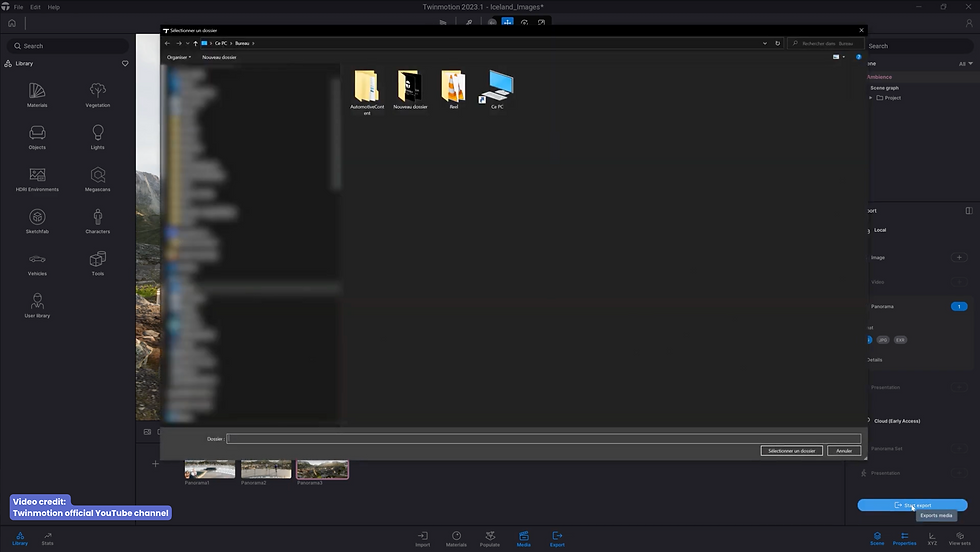
Panorama Render Settings
Setting | Options |
File format | PNG, JPG, EXR |
Panorama type | Standard (mono) or 3D (stereo — recommended for VR) |
Resolution | 2K to 16K equirectangular |
Settings | Lighting, refinement, motion blur, frame rate |
Quality | Various settings for render speed vs. quality trade-off |
Tip: For the best VR experience, render in 3D (stereo) mode at high resolution. The difference in perceived depth and immersion is significant. |
How to View Twinmotion Panoramas Using SENTIO VR
Export panoramas to your desktop
Render your 360 panoramas in Twinmotion using the steps described above. Export them locally as JPG or PNG files.
Upload to your SENTIO VR account
Go to https://app.sentiovr.com/login, log in, click Create New Project (or open an existing project), and upload your 360 panoramas.

Create your virtual tour
Arrange the panoramas in order, add hotspots for navigation between viewpoints, and customize your tour with floor plans, notes, audio, and video to create an interactive walkthrough experience.

Add audio hotspots, floor plans, notes, audio and video
View in VR on Meta Quest
Download the SENTIO VR app from the Meta Quest Store. On the web portal, note your 6-digit access code. Enter it in the SENTIO VR app and start viewing your Twinmotion designs in immersive VR. No USB cable, no PC connection required.

Share with clients and collaborate
Share the 6-digit code or QR code with clients and stakeholders so they can view the design on their own headsets — no SENTIO VR license required for view-only access. For team design reviews, use multi-user VR meetings where multiple people can join remotely.

A Dedicated VR App Built for Architecture
Unlike browser-based VR viewers, the SENTIO VR app for Meta Quest is purpose-built for architectural VR presentations. Key features include:
6-digit access codes & QR codes: No manual file transfers. Enter a code or scan a QR code and you are instantly inside the design.
Cast to a URL: Share your VR view on any screen via a URL — perfect for client presentations where not everyone has a headset.
Offline downloads: Download tours to your headset for presentations on construction sites or locations without internet.
Multi-user VR meetings: Multiple participants can join the same VR space remotely to review designs together in real time.
Works with any renderer: Upload panoramas from Twinmotion, Enscape, Lumion, V-Ray, D5 Render, or any tool that outputs equirectangular 360 images.
Comparison: Twinmotion Cloud vs. SENTIO VR
Once you have your Twinmotion panoramas, you need a platform to create virtual tours and share them in VR. Here is how Twinmotion Cloud (Epic Games’s built-in cloud platform) compares with SENTIO VR:
Feature | Twinmotion Cloud | SENTIO VR |
Upload panoramas to cloud | ✔ | ✔ |
Share link with clients | ✔ | ✔ |
Share via QR code | ✔ | ✔ |
Password-protected sharing | ✔ | ✔ |
Virtual tour with panorama sets | ✔ | ✔ |
Embed panoramas on website | ✔ | — |
Dedicated VR app on Meta Quest | — | ✔ |
6-digit access codes | — | ✔ |
View-only mode (no license for viewers) | — | ✔ |
Offline VR downloads to headset | — | ✔ |
Multi-user VR meetings (remote) | — | ✔ |
Design review tools (annotations, notes, screenshots & reports) | — | ✔ |
Cast VR view to a URL for screen-sharing | — | ✔ |
Supports panoramas from ANY renderer | — | ✔ |
Share VR Designs with Anyone — No License Required
One of the biggest challenges in architectural VR is getting clients and external stakeholders into your designs without complicated setup or software installs. SENTIO VR solves this with view-only mode.
Every design in SENTIO VR has its own individual access code. When someone enters this code on an unlicensed headset, they get view-only access to that specific design. They can look around, walk through the space, and experience the design at full scale — without needing a licensed account, a PC, or any setup.
Licensed vs. View-Only Access
Capability | Licensed Headset | View-Only (Unlicensed) |
View 360 tours | ✔ | ✔ |
View 3D walkthroughs | ✔ | ✔ |
Access via QR code or 6-digit code | ✔ | ✔ |
Full project library | ✔ | — |
VR tools (measurement, markup, etc.) | ✔ | — |
Multi-user collaboration | ✔ | — |
Offline downloads | ✔ | — |
This makes SENTIO VR ideal for client presentations, design reviews with external consultants, and on-site walkthroughs where you want to hand someone a headset and say "take a look" — with zero setup required.
Frequently Asked Questions
Can I view Twinmotion designs directly on Meta Quest without a PC?
Not with Twinmotion’s built-in VR mode — that requires a PC connection via Quest Link or Air Link. However, you can export 360 panoramas from Twinmotion and view them on a standalone Meta Quest headset using SENTIO VR’s dedicated app, with no PC required.
Does Twinmotion officially support Meta Quest 3?
Yes. Twinmotion supports the Meta Quest 3 for PC-tethered VR via Quest Link or Air Link. The Quest 3S is also supported. Ensure your PC meets the system requirements listed above.
What is Twinmotion Cloud?
Twinmotion Cloud is Epic Games’ cloud-based platform for sharing Twinmotion panoramas, images, and presentations via links and QR codes. It supports VR viewing in a web browser and is built directly into recent versions of Twinmotion for seamless uploads.
How does SENTIO VR compare to Twinmotion Cloud?
Twinmotion Cloud is tightly integrated with Twinmotion and great for quick sharing. SENTIO VR offers a dedicated Meta Quest app, 6-digit access codes for license-free sharing, multi-user VR meetings, offline downloads, and works with panoramas from any renderer — not just Twinmotion. See the comparison table above for a detailed breakdown.
Can clients view my Twinmotion designs without any license or software?
Yes. With SENTIO VR, clients can view your specific design using a 6-digit code or QR code on any Meta Quest headset in view-only mode — no license, no app install beyond the free SENTIO VR app, and no PC needed.
What is the difference between Standard and 3D panoramas?
Standard panoramas render a single image shown to both eyes (mono). 3D panoramas render separate left and right eye images, creating true 3D depth perception. For VR presentations, 3D (stereo) is strongly recommended for the most immersive experience.
Can I use the same panoramas in SENTIO VR that I upload to Twinmotion Cloud?
Yes. You can export your Twinmotion panoramas locally (as JPG or PNG files) and upload them to any platform, including both SENTIO VR and Twinmotion Cloud. The panorama files are standard equirectangular images that work across platforms.
Conclusion
Getting your Twinmotion designs into VR on Meta Quest comes down to two approaches: PC-tethered (Quest Link / Air Link) for real-time walkthroughs during design development, and cloud-based 360 panoramas for portable, shareable client presentations.
For client-facing VR presentations and design reviews, the cloud-based approach with SENTIO VR offers the most complete workflow:
No VR-ready PC needed during presentations — everything runs on a standalone Meta Quest headset
No cables or manual file transfers — upload once, share via cloud
6-digit codes and QR codes — instant VR access for anyone, no license required
Interactive tours — add hotspots, floor plans, notes, and multimedia
Multi-user VR collaboration — review designs together in real time from anywhere
Works with any renderer — not locked to Twinmotion; also supports Enscape, Lumion, V-Ray, and more
Whether you are walking a single client through a design or running a remote design review with your entire project team, SENTIO VR makes the Twinmotion-to-VR workflow simple and professional.
Ready to bring your Twinmotion designs to VR? Try SENTIO VR free and experience your architectural visualizations in immersive virtual reality. |
![How to View 360 Photos in VR Using Meta Quest [2026]](https://static.wixstatic.com/media/1f03b8_2f5f1710853f4f47a0c24995a5f4b3ff~mv2.png/v1/fill/w_980,h_551,al_c,q_90,usm_0.66_1.00_0.01,enc_avif,quality_auto/1f03b8_2f5f1710853f4f47a0c24995a5f4b3ff~mv2.png)

